
Grain Bin Unload Problems: What to Check When Grain Won't Flow
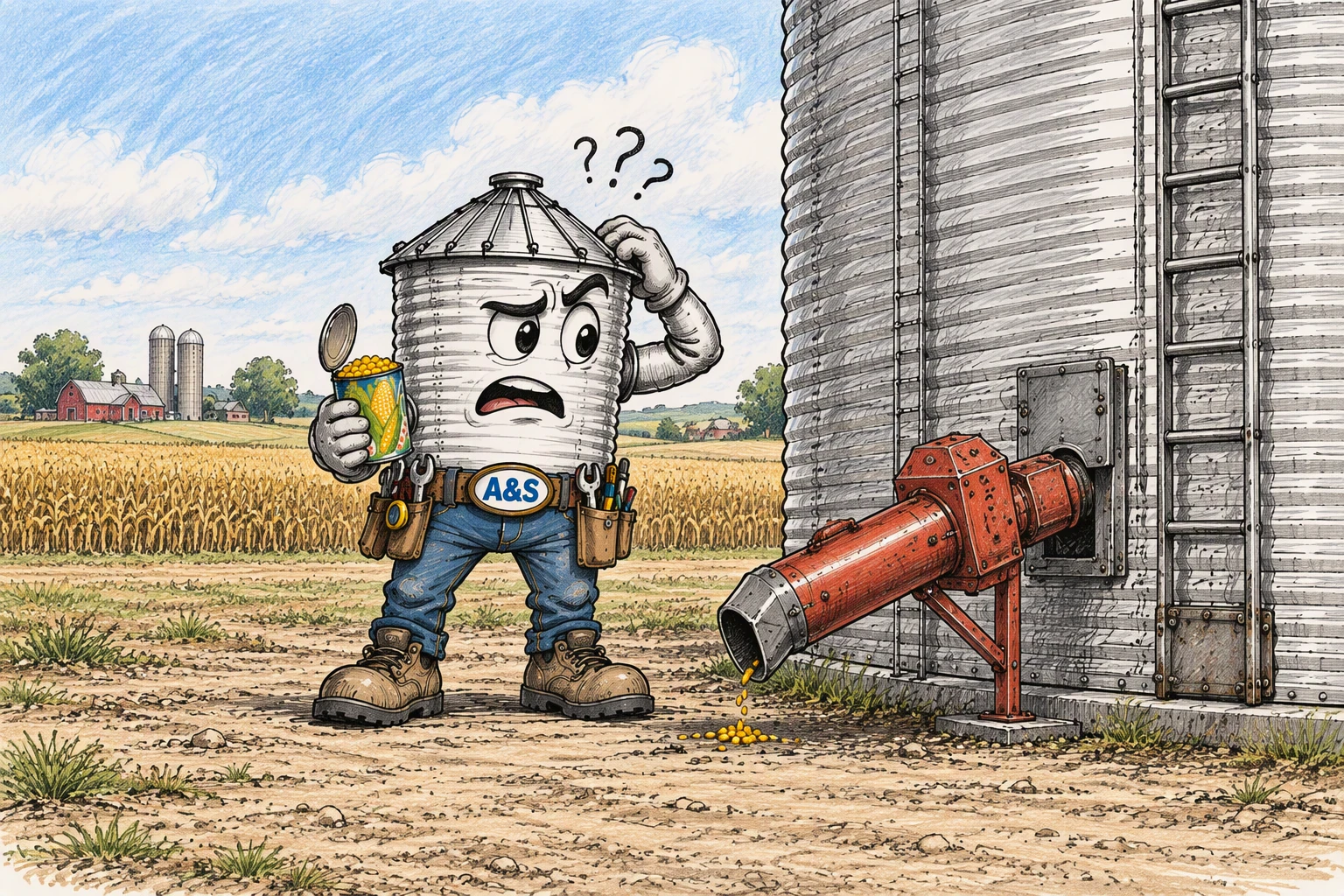
Today we're troubleshooting the other end of grain storage: getting the grain back out.
If your grain bin won't unload, don't immediately assume the auger is bad. A grain bin unload problem can involve the grain itself, the sump or slide gate, unload screw, powerhead, drive components, sweep, gearbox, or another part of the unload system.
The first clue is usually what the system is doing differently than normal.
Is grain not coming out at all? Is capacity suddenly down? Is the drive operating but grain isn't moving normally? Did the problem start when you opened the center sump, or did it show up later when it was time to run the sweep?
Those symptoms can help narrow down where to look.
Benny's first rule: A plugged bin is frustrating. A grain bin is also no place to take shortcuts. Never enter a bin to deal with bridged or flowing grain, and don't inspect or service moving or energized unload equipment. Follow the equipment manufacturer's safety procedures and use qualified help where appropriate.
Start With the Symptom
Before you start ordering grain bin unload parts, write down exactly what's happening.
A few different complaints can all sound like “the unload doesn't work,” but they don't necessarily point to the same problem.
Problem 1: No Grain Is Coming Out
You open the unload and get little or nothing.
One possibility is that grain isn't flowing freely to the center sump. Clumped or crusted material can create problems around the sump and interfere with normal grain flow.
A&S currently carries the Grain Saver Center Sump Clump Buster, which is designed to fit over most center sumps and break up clumps so that grain can continue flowing toward the unload. [asagsales.com]
That doesn't mean every no-flow problem is a plugged sump, though. The issue could be elsewhere in the unload system.
Before doing anything else, determine whether the problem appears to be grain reaching the unload or the unload equipment moving the grain.
Never enter a bin to investigate a suspected blockage or bridged grain.
Problem 2: The Bin Unloads, but Much Slower Than It Used To
A noticeable reduction in unloading performance deserves attention.
Start with what changed:
- Did the problem appear suddenly or gradually?
- Is the grain flowing consistently?
- Is the unload making a new sound?
- Has anything in the drive system recently been repaired or replaced?
- Does the problem occur throughout unloading or only at a particular stage?
A reduced unload rate doesn't automatically tell you which component is responsible.
The A&S unload catalog separates these systems into components including screws, tubes, powerheads, sweeps, U-trough systems, and replacement parts. [asagsales.com], [asagsales.com]
Rather than buying parts based on one symptom, identify the unload system and determine where the change is occurring.
Problem 3: The Unload Screw Needs Attention
The unload screw is doing the actual work of moving grain through the tube, so its condition matters.
A&S currently carries Grain Saver 8" Unload Screw and Grain Saver 10" Unload Screw options. The current product information identifies them as right-hand, full-pitch unload screws, and specifically warns not to start or stop the auger under load. [asagsales.com], [asagsales.com]
If you suspect a screw problem, don't simply order one based on the bin diameter.
You'll want to identify the existing unload system first.
At a minimum, gather:
- Manufacturer
- Unload/tube size
- Existing equipment or model information
- Clear photos
- What the system is doing differently
A&S review required: Add the exact measurements needed to identify a replacement screw before publishing.
Problem 4: The Powerhead Isn't Driving the System Normally
The powerhead is another major piece of the unload system.
A&S currently carries both Grain Saver Horizontal Powerhead and Grain Saver Inclined Powerhead - 25 degree configurations for bin unload systems. The horizontal model drives the unload system with an easy-off motor mount and belt system, while the inclined model is supplied with a motor mount, driven pulley, drive belts and shields. [asagsales.com], [asagsales.com]
If the powerhead or drive isn't operating normally, shut the system down according to the manufacturer's procedure rather than trying to diagnose moving equipment.
Things like electrical work, motor troubleshooting and servicing belt-driven equipment should be handled by someone qualified for that work.
The useful thing a bin owner can do safely is document the symptom.
For example:
- Does the problem start immediately?
- Did you hear or see anything unusual before shutdown?
- Has the motor, pulley or other drive equipment recently been changed?
- Does the problem only happen under load?
That information can make it much easier to determine the next step without guessing.
Problem 5: The Main Unload Works, but the Sweep Doesn't
This narrows things down considerably.
Once the grain has been drawn down far enough for the sweep stage, you're dealing with a different set of components.
A&S currently sells two Grain Saver electric bin sweep configurations: a 5-inch sweep for 6-inch or 8-inch tubes and a 7-inch sweep for 10-inch tubes. The listings include components such as the backboard, drive wheel, motor mount, sheaves, belts and belt guard. [asagsales.com]
So if you're replacing a sweep, the unload tube size matters.
Don't buy a sweep simply because the length appears right.
Start by identifying the existing tube and sweep configuration.
Problem 6: Your Powersweep Is Having Drive Problems
A powersweep adds additional equipment that could become part of your troubleshooting.
A&S currently carries replacement upper and lower powersweep gearboxes as well as a Grain Saver Reduction Wheel End Drive Kit. A&S lists the end-drive kit in 5:1 and 10:1 configurations for 8-inch and 10-inch powersweeps. [asagsales.com]
This is an area where the exact configuration matters.
A gearbox that looks similar isn't necessarily the gearbox your system needs.
Before ordering a replacement, identify:
- Manufacturer
- Sweep size
- Upper or lower gearbox, where applicable
- Existing gearbox information
- Photos of the equipment
- Other identifying information from the system
A&S review required: Confirm the exact identification process A&S uses for powersweep replacement components.
Problem 7: The System Has a Recurring Sump Plugging Problem
A one-time problem and a problem that occurs repeatedly are worth thinking about differently.
If material repeatedly clumps around the center sump, figuring out why it's happening matters in addition to figuring out how to get the bin flowing again.
Grain condition can affect how a bin unloads. Moisture, fines, foreign material, crusting and damaged grain can all affect how material behaves in storage.
That also means an unload problem isn't always strictly an unload-equipment problem.
If grain condition is part of the problem, fixing a mechanical component won't necessarily fix the underlying cause.
A&S currently carries a Grain Saver Center Sump Clump Buster for center-sump applications as well as the Sump Saver Mighty Mini, which is another product intended for dealing with plugged-bin situations. [asagsales.com]
Because plugged bins can present serious grain-entrapment hazards, follow manufacturer procedures and use qualified assistance rather than entering the bin or trying to manually break a blockage loose from inside.
What Information Should You Have Before Ordering Grain Bin Unload Parts?
Here's the part of this lesson I'd save.
If you call A&S about an unload problem, the more information you've got, the less guessing everybody has to do.
Get these five things:
1. Manufacturer
Look for identification on the unload, sweep, powerhead or related equipment.
2. Unload size
Don't assume. Identify what size system you're actually working with.
A&S, for example, currently lists both 8-inch and 10-inch unload screws as well as sweep configurations intended for different tube sizes. [asagsales.com], [asagsales.com]
3. Pictures
Get clear photos of the equipment and any labels or identifying features that can be photographed safely from outside the bin and away from energized equipment.
4. Describe the symptom
“It's broke” doesn't give us much to work with.
“Center sump opened but we're getting almost no grain” is better.
“Main unload worked normally, but we developed a problem when we got to the sweep” is better yet.
5. Identify what changed
If the motor, powerhead, gearbox, sweep or other component was recently changed, mention it.
That can be an important part of diagnosing a new problem.
Repair One Part or Look at the Whole Unload System?
Sometimes replacing one worn or failed component makes sense.
Other times, an old unload system has enough issues that continuing to replace pieces doesn't solve the bigger problem.
A&S's current unload offering includes individual screws, powerheads, sweeps, gearboxes and accessories as well as complete 8-inch and 10-inch Grain Saver U-Trough equipment for powersweep unload systems. [asagsales.com], [asagsales.com]
If several major components are worn, you're increasing bin capacity, or the existing system no longer suits how you use the site, it's worth comparing another repair against an unload-system upgrade.
That's especially true when you're already planning other work on the bin.
Benny's Grain Bin Unload Troubleshooting Checklist
When a grain bin won't unload properly, work through the problem in this order:
- Identify exactly what isn't working.
- Determine whether grain is reaching the unload normally.
- Identify the unload manufacturer and size.
- Determine whether the problem is in the main unload or sweep stage.
- Document unusual noises, behavior or recent equipment changes.
- Get photos and equipment information before ordering parts.
- Keep people away from moving equipment and flowing or bridged grain.
- Call for help rather than guessing at compatibility.
The goal isn't to tear the whole system apart.
It's to narrow the problem down enough to make the right repair the first time.
Need Help Finding the Right Grain Bin Unload Part?
A&S carries Grain Saver unload screws, tubes, powerheads, electric bin sweeps, U-trough equipment, powersweep components, sump products, and other unload parts. [asagsales.com], [asagsales.com], [asagsales.com]
Browse the A&S unload-equipment selection, or contact A&S with your equipment information and photos if you're not sure what part you're looking for.
A good description of the problem plus the right equipment information is a whole lot better than ordering a part because it looks close.
Frequently Asked Questions
Why won't grain come out of my grain bin?
There isn't one universal cause. A no-flow condition can involve grain not flowing normally toward the sump or an issue elsewhere in the unload system. Because bridged and flowing grain create serious hazards, never enter a bin to investigate or manually clear a blockage.
How do I know what size grain bin unload I have?
Identify the existing equipment rather than inferring the size from the bin itself. Look for manufacturer and model information and safely document the tube, powerhead, sweep and other components. Current A&S products demonstrate why size matters: the catalog includes 8-inch and 10-inch screws and sweep models intended for particular tube sizes. [asagsales.com], [asagsales.com]
Can I replace just the grain bin unload screw?
Replacement unload screws are available as individual components. A&S currently carries Grain Saver 8-inch and 10-inch unload screws. Compatibility with the rest of the existing system should be confirmed before ordering. [asagsales.com]
What size sweep do I need?
It depends on the existing unload system. Current A&S listings include a 5-inch Grain Saver sweep for 6-inch or 8-inch tubes and a 7-inch sweep for 10-inch tubes. [asagsales.com]
What should I do if my grain bin sump is plugged?
Keep people out of the bin and away from flowing or bridged grain. Do not enter the bin to manually clear the blockage. Follow the equipment manufacturer's procedures and use purpose-built equipment or qualified assistance appropriate to the situation.