
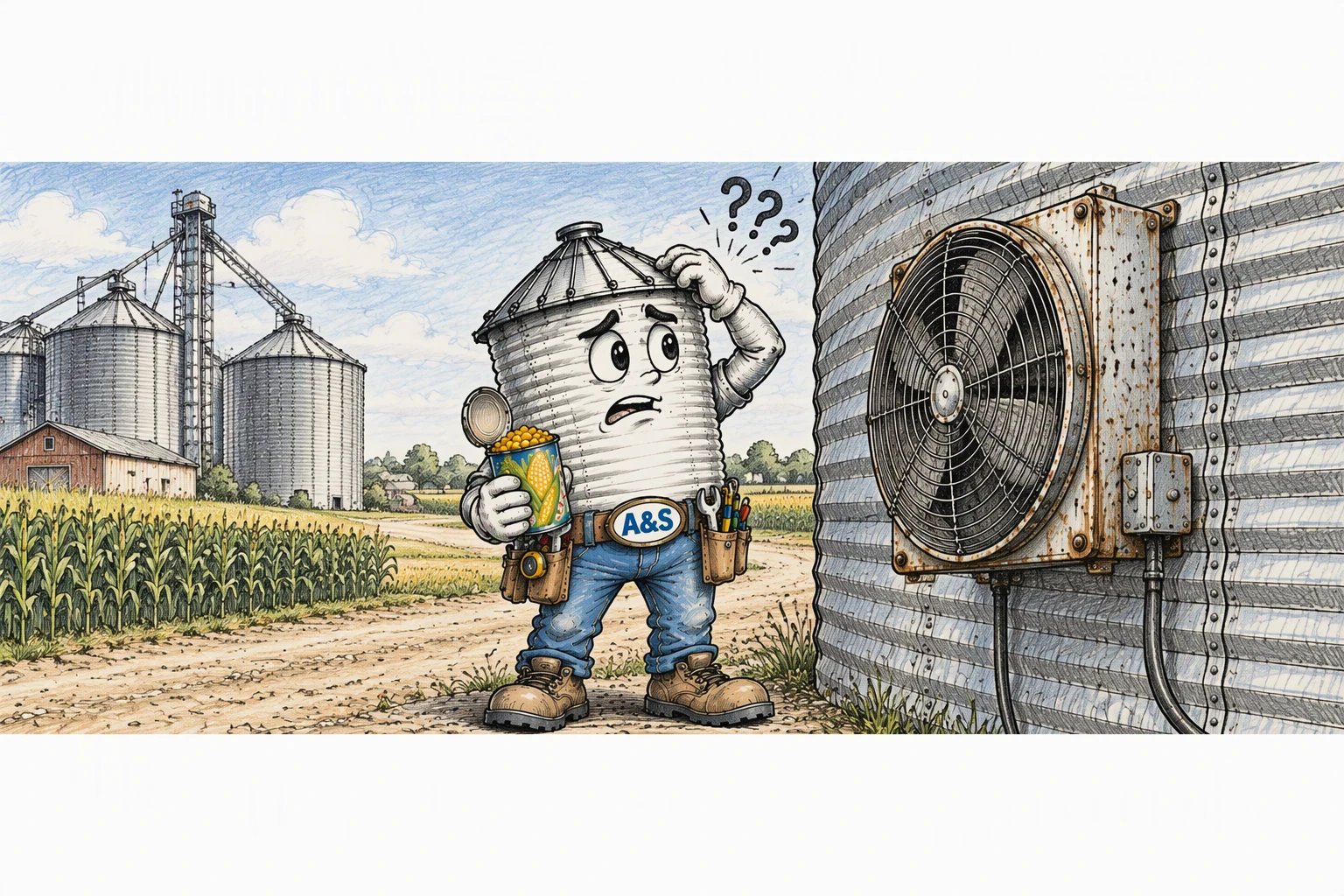
How to Replace an Old Grain Bin Fan: What to Know Before You Buy
If your old grain-bin fan has finally given up, don't automatically replace it with another fan of the same horsepower.
A good replacement starts by identifying exactly what you have, confirming what the bin actually needs, and then matching the new fan to the airflow requirement, static pressure, electrical service, transition, controls, and any other connected equipment.
Sometimes that leads right back to a similar fan.
Sometimes an old installation gives you an opportunity to make a better choice.
Here's what to check before you order.
First Question: Does the Entire Fan Need to Be Replaced?
Before buying a complete fan assembly, determine what actually failed.
The problem could involve the:
- electric motor;
- fan wheel or blade;
- controls;
- wiring or electrical components;
- bearings or other mechanical components;
- housing;
- transition; or
- complete fan assembly.
That distinction matters because A&S also sells electric motors separately from its fan assemblies. [asagsales.com], [asagsales.com]
But don't assume that replacing one component is always the right repair.
If the fan is old, damaged, badly deteriorated, improperly sized, or difficult to source parts for, replacing the complete assembly may make more sense.
Benny's tip: Start by figuring out what you have and what failed. Don't order a motor just because the motor isn't turning.
Electrical diagnosis and repair should be performed by qualified personnel. Never work on energized fan equipment.
Before Removing Anything, Identify the Old Fan
One of the most useful things you can do is document the existing equipment.
Look for the manufacturer's nameplate or model information.
When it's safe to do so, collect:
- manufacturer;
- model number;
- horsepower;
- voltage;
- phase;
- fan diameter;
- motor information;
- control information;
- transition or outlet dimensions;
- heater model, if equipped; and
- clear photos of the overall installation and equipment labels.
The model number is especially valuable.
It gives A&S a much better starting point than:
“I've got an old 10-horse fan.”
Why?
Because horsepower doesn't tell the whole story.
Don't Replace a Fan Based on Horsepower Alone
This is probably the most important lesson in the article.
A 10 HP fan isn't automatically equivalent to another 10 HP fan.
Horsepower only tells you how much mechanical power the motor is rated to deliver.
What we're ultimately interested in is airflow at the static pressure created by your grain and aeration system.
Different fan designs can perform differently under the same conditions.
That's why manufacturers publish fan performance data.
Chief Agri Grain Aeration Fans, for example, publishes CFM ratings at different static pressures for its Caldwell fan models, demonstrating how airflow changes as resistance rises. [agri.chiefind.com]
So when you're replacing a fan, there's an important question to ask:
Did the old fan actually do the job well?
If it did, its performance gives us useful information.
If it didn't, simply buying the modern equivalent of an undersized fan doesn't solve the underlying problem.
Ask Whether the Old Fan Was Actually Working Well
An equipment failure and an equipment-sizing problem aren't necessarily the same thing.
Think about how the bin performed before the fan failed.
Was the fan able to accomplish the job you expected?
Did you struggle to move enough air through deeper grain?
Have you changed crops?
Are you filling the bin deeper than you used to?
Are you now trying to do more natural-air drying?
Has the bin or aeration system been modified?
If anything about the application has changed, replacement time is a good time to revisit fan sizing.
Don't spend money reproducing a problem you've had for years.
Check Airflow and Static Pressure
The fan has to do more than turn.
It has to move the necessary amount of air through a bin full of grain.
Static pressure is the resistance the fan works against.
As resistance increases, fan airflow changes. Different fan designs also handle that resistance differently.
For example, Chief Agri positions axial fans for shallower, lower-static-pressure aeration applications, while its centrifugal lines are designed for medium-to-high static pressures and deeper grain. [agri.chiefind.com]
AGI similarly offers different axial and centrifugal designs for different storage depths and pressure requirements. [aggrowth.com]
That means replacing an old fan doesn't necessarily mean replacing it with the same type of fan either.
The real question is:
What fan delivers the airflow this bin needs at its expected operating pressure?
Our What Size Fan Do I Need for My Grain Bin? lesson goes deeper into that calculation.
Should You Stay With the Same Fan Type?
Maybe.
If the old fan was properly sized and you're happy with its performance, staying with a similar fan design can simplify the replacement.
But if conditions have changed, it's worth looking at your options.
A&S currently offers several fan styles, including:
- axial fans;
- inline centrifugal fans;
- high-speed centrifugal fans; and
- low-speed centrifugal fans. [asagsales.com]
A&S currently lists axial models in both single- and three-phase configurations, as well as several centrifugal configurations. [asagsales.com]
We've covered the differences in our Axial vs. Centrifugal Grain Bin Fans lesson.
The important point for a replacement job is this:
Don't let the old fan dictate the new fan until you've confirmed the old one was actually right for the application.
Check Your Electrical Service
The new fan also has to work with the power available at the site.
Before ordering, verify the existing electrical information rather than assuming.
Important information includes:
- single-phase or three-phase;
- voltage;
- motor horsepower;
- existing controls; and
- electrical requirements of the proposed replacement.
For example, A&S currently lists fan options in both single- and three-phase configurations. [asagsales.com]
Changing horsepower, motor, voltage, phase, controls, or fan type can have electrical implications.
A replacement fan should never simply be connected because “the wires are already there.”
Have a qualified electrician verify the electrical requirements and make any necessary changes. Follow the fan manufacturer's installation instructions and applicable electrical requirements.
Measure the Transition Before Ordering
Here's an easy thing to overlook.
The fan still has to physically connect to the bin.
The transition is the duct between the fan and the bin. A&S sells transitions and reducers in addition to fans. [asagsales.com]
Don't assume a new fan will bolt directly onto a transition just because the horsepower is similar.
If you're changing:
- manufacturer;
- fan series;
- fan diameter;
- fan style; or
- fan outlet size,
the physical connection may be different.
Before ordering, identify or measure the existing transition and compare it with the proposed fan's requirements.
A few minutes spent checking dimensions beats discovering the mismatch after the new fan arrives.
Don't Forget the Heater
If there's a heater tied into the existing fan system, stop and verify compatibility before ordering the replacement fan.
Fan type, dimensions, airflow, heater style, mounting arrangement, and manufacturer requirements can all matter.
Do not assume an existing heater will fit or operate correctly with a different fan simply because the horsepower looks similar.
This is especially important if you're considering changing from one fan design to another.
Manufacturer guidance varies. As one example of why model-specific verification matters, GSI Fans and Heaters identifies heater limitations for some of its inline and high-speed centrifugal fan designs. [grainsystems.com]
This is one area where guessing can become an expensive mistake.
A&S review required: Before publication, confirm the exact heater-compatibility information the A&S sales team wants customers to provide for the brands A&S currently sells.
Check Roof Venting Too
Increasing fan airflow means air still needs somewhere to go.
If you're substantially changing the aeration system or increasing airflow, roof venting deserves to be evaluated as part of the system.
A&S currently sells roof exhaust fans as part of its grain-bin accessory lineup. For example, the current Caldwell Roof Exhaust Fan listing includes 18-inch and 24-inch configurations. [asagsales.com]
That doesn't mean every fan replacement requires a roof exhauster.
It means that fan, floor, grain and exhaust path work as a system.
If you're making a major change instead of a like-for-like replacement, look at the whole airflow path.
What Information Should You Send A&S?
Want to make the replacement conversation faster?
Start here.
Information about your existing fan
- Manufacturer
- Model number
- Horsepower
- Voltage
- Phase
- Fan diameter
- Photos of the nameplate
- Full photo of the fan and transition
- Control information
Information about your bin
- Bin diameter
- Approximate grain depth
- Crop
- Intended use of the fan
- Aeration floor or duct configuration
Information about connected equipment
- Heater manufacturer/model, if equipped
- Transition dimensions
- Controls
- Any reducers or unusual ducting
If the model plate is readable, take a photo of it.
That's much better than trying to remember what the label said when you're standing in the shop later.
Can You Upgrade When Replacing an Old Fan?
Yes, replacement can be a good opportunity to reconsider the setup.
But don't equate “upgrade” with “more horsepower.”
Depending on the existing system, useful changes could include:
- choosing a fan better suited to the expected static pressure;
- moving to a different fan design;
- correcting an undersized fan;
- replacing aging controls;
- correcting transition compatibility;
- reviewing roof venting; or
- replacing a worn or inappropriate motor.
For example, A&S currently sells High Speed Inline Centrifugal Fans in 18- to 28-inch diameters and 3 to 15 HP configurations, according to the current product listing. [asagsales.com]
A&S also lists Low Speed Centrifugal Fan - Three Phase- 1750 RPM models for deeper-grain, higher-static-pressure applications, with the product page listing 5 through 25 HP configurations. [asagsales.com]
Those aren't automatic recommendations for your bin.
They're examples of why the replacement discussion can involve more than simply finding another version of the fan that's sitting there today.
What If You Can't Identify the Old Fan?
That's common with older equipment.
Maybe the nameplate is gone.
Maybe it's painted over.
Maybe the manufacturer isn't around anymore.
Don't guess.
Collect as much information as possible:
- Photos from several angles
- Fan diameter
- Motor nameplate
- Transition dimensions
- Electrical service
- Bin diameter
- Grain depth
- Crop
- What you're trying to accomplish with the fan
From there, you can work forward from what the bin needs rather than trying to reverse-engineer an unidentified fan.
The Bottom Line
Replacing an old grain-bin fan should not start with:
“Give me another 10 HP.”
It should start with:
What fan is there now?
What failed?
Did the old fan perform well?
How much airflow does the bin need?
What static pressure does the fan need to overcome?
What electrical service is available?
Will the new fan fit the transition?
Is there a heater or other equipment that needs to remain compatible?
What failed?
Did the old fan perform well?
How much airflow does the bin need?
What static pressure does the fan need to overcome?
What electrical service is available?
Will the new fan fit the transition?
Is there a heater or other equipment that needs to remain compatible?
Answer those questions first.
Then you're replacing the fan with something that fits the bin and the job, instead of simply replacing what happened to be there before.
Need a Replacement Grain Bin Fan?
A&S Ag Sales currently carries axial, inline centrifugal, high-speed centrifugal, and low-speed centrifugal fans, along with electric motors, transitions, reducers, and other grain-storage components. [asagsales.com], [asagsales.com]
Not sure what replaces your old fan? Send A&S photos of the fan and nameplate along with your bin diameter, grain depth, crop, electrical service, and what you're trying to accomplish. The goal is to identify the right replacement rather than guess from horsepower.
Frequently Asked Questions
Can I replace my grain-bin fan with one that has the same horsepower?
Maybe, but matching horsepower alone does not establish that two fans will perform the same. Compare the required airflow and static pressure, fan type, electrical requirements, physical dimensions, transition, controls, and any connected heater.
Can I put a bigger fan on my grain bin?
Potentially, but bigger is not automatically better. The aeration floor or ducting, roof venting, electrical service, transition, and intended airflow all need to work together with the new fan.
Should I replace the motor or the whole grain-bin fan?
It depends on what failed and the condition of the rest of the equipment. A&S currently sells both complete fans and electric motors, so identifying the actual failure is the first step. [asagsales.com], [asagsales.com]
Can I replace an axial fan with a centrifugal fan?
Potentially, but it shouldn't be treated as a drop-in substitution. Confirm airflow and static pressure requirements along with electrical, transition, control, heater, and physical compatibility. Chief Agri designs its axial and centrifugal products for different pressure and grain-depth conditions. [agri.chiefind.com]
What if I don't know the model of my old grain-bin fan?
Take clear photos of the fan, motor nameplate, controls, and transition. Also collect the fan diameter, bin diameter, grain depth, crop, intended use, and electrical information. Those details provide a starting point for identifying a suitable replacement.
Do I need a new transition with a replacement fan?
Not necessarily. It depends on whether the new fan's physical connection matches your existing transition. A&S sells transitions and reducers separately, so compatibility should be checked before ordering. [asagsales.com]