
How to Choose a Grain Bin Fan | Benny's School House
Benny's School House: How to Choose the Right Grain Bin Fan
Class is in session. Today's lesson: matching the right fan to your bin.
The right fan keeps your grain cool, dry and worth full price. The wrong one either runs up your power bill or lets grain spoil. Here's a simple way to pick one.
Step 1: What is the fan's job?
Start here, because the job sets how much air you need.
- Aeration (cooling and conditioning): Keeps temperatures even in dry grain. The target is a low airflow, usually about 0.1 to 0.25 CFM per bushel. [pami.ca]
- Natural-air drying: Pulls moisture out of grain using outside air. This takes much more air, about 0.5 to 1 CFM per bushel. [pami.ca]
CFM means cubic feet of air per minute. Recommendations are given per bushel of grain, so the same fan can be right for one bin and wrong for another.
Step 2: Do the math
Multiply your bushels by your target CFM per bushel.
Bushels × CFM/bu = total CFM needed
For example, a 20,000-bushel bin aerated at 0.2 CFM/bu needs about 4,000 CFM. That should be the airflow the fan delivers once it's pushing through your grain, not its free-air rating. [farmshopmfg.com]
Step 3: Check static pressure
Static pressure is the resistance your fan has to push against. Deeper grain means more resistance, and more resistance means less airflow. Fines (broken kernels, weed seeds and dirt) also add resistance, so a bin full of clean grain flows better than one full of fines. [pami.ca] [extension.umn.edu]
This is why a fan that works well in a shallow bin can disappoint in a tall one. The fan's performance chart shows how much air it delivers at each pressure. That's the number to check.
Step 4: Choose a fan type
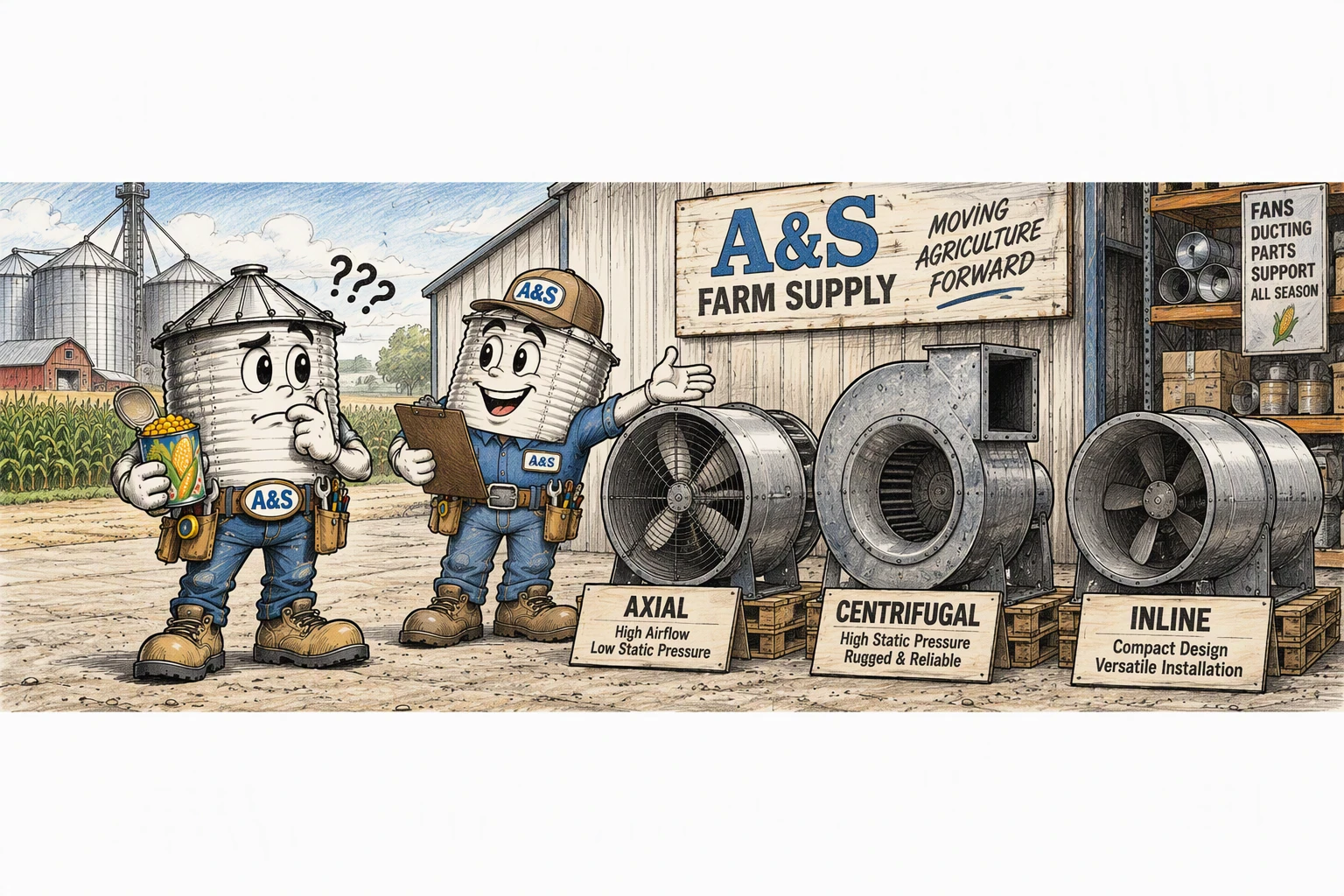
| Fan type | Best for | What to know |
|---|---|---|
| Axial | Shallower grain and lower static pressure | High airflow at low resistance. Caldwell sells them in 12" to 28" diameters. [agri.chiefind.com] |
| In-line centrifugal (3450 RPM) | Medium static pressure and deeper grain | Compact tube-style housing that's easy to fit to a bin. Compact and quiet, and it can be upgraded with a heater later. [agri.chiefind.com] |
| High-speed centrifugal (3450 RPM) | Deep grain and high static pressure | Built for the jobs where axial or in-line fans can't get enough air through. |
| Low-speed centrifugal (1750 RPM) | Larger bins and deep grain | Quieter, efficient airflow at higher static pressures. Choose from 5 HP and up. |
Rule of thumb: the deeper your grain and the longer your ducting, the more you should lean toward a centrifugal fan.
Step 5: Pick horsepower and power supply
Once you know the airflow and static pressure, pick the horsepower that delivers them. Then match your power: A&S carries single-phase and three-phase fans. Check what you have available at the bin before you order, because single-phase is limited in how much horsepower it can run.
Step 6: Plan the full system
The fan is one part of the system. Before you order, confirm:
- Vents: Extension guidance for natural-air drying calls for about 1 square foot of roof vent area per 1,000 CFM of airflow. [extension.umn.edu]
- Ducting and floor: Your aeration floor or half-round ducting needs to carry the air evenly.
- Transitions: The fan has to connect cleanly to your ducting.
- Heater: Planning to add supplemental heat now or later? Choose a fan that supports a heater.
- Motor and controls: Make sure the electrical side matches the fan.
Want a second opinion on the numbers?
The University of Minnesota offers a free online fan selection tool. It compares your bin against more than 200 commercially available fan models. It's a good way to sanity-check any recommendation. [extension.umn.edu]
Quick checklist
Gather these before you shop or call:
- Bin diameter
- Grain depth (eave height)
- Crop and moisture
- Aeration or natural-air drying
- Single phase or three phase
- Heater now or later
- Existing ducting or floor type
Still not sure? Ask Benny's friends at A&S.
Every bin is a little different. Send us your bin size, crop and grain depth, and we'll help you match the fan to the job.