
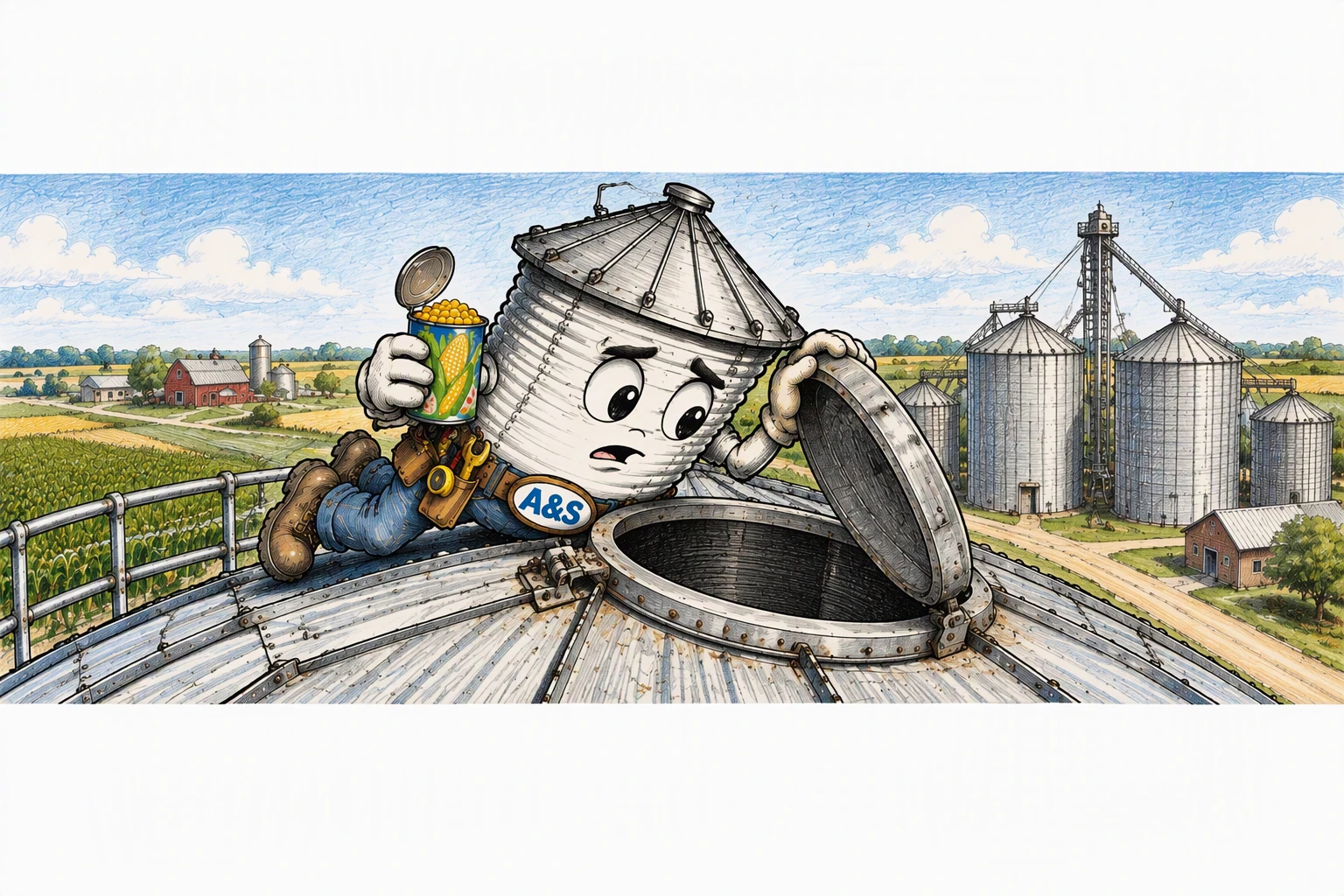
Grain Bridging in a Bin: Why It Happens and How to Prevent It
Today's lesson is about grain that quits acting like grain.
Grain bridging in a bin happens when kernels stick together strongly enough to form a crust or self-supporting mass instead of flowing freely during unloading. High moisture, mold, spoilage, and generally poor grain condition are important warning factors. NDSU Extension specifically identifies moldy, high-moisture, and poor-condition grain as conditions that can lead to bridging. [ndsu.edu]
A bridge is more than an unloading headache.
As grain unloads from underneath it, the bridged material can remain suspended while a hidden cavity develops below. What looks like a solid grain surface may have little or nothing underneath it. [ndsu.edu]
That's why our first rule is simple:
If you suspect bridged grain, stay out of the bin.
The right time to deal with grain bridging is before it develops.
What Is Grain Bridging in a Bin?
Normally, grain should flow toward the unload as the bin empties.
Bridging happens when part of the grain mass sticks together rather than moving with the grain underneath it.
Think of it like an arch.
The grain remains supported across an area while grain below it is removed. That can leave a cavity under what appears to be a normal grain surface.
NDSU Extension warns that this surface can give the false impression that it's safe to stand on. If the crust collapses, the person standing on it can fall into the cavity and be buried as the grain falls with them. [ndsu.edu]
So we're going to discuss recognition and prevention, not instructions for getting on top of a bridge and breaking it apart.
What Causes Grain to Bridge?
There isn't one cause behind every grain bridge.
But grain condition is the place to start.
High-Moisture Grain
Moisture is one of the biggest warning signs.
When stored grain is too wet or develops high-moisture areas, it is more likely to deteriorate and lose the free-flowing characteristics you want at unloading time.
NDSU Extension specifically lists high moisture as one of the conditions associated with bridged grain. [ndsu.edu]
Penn State Extension likewise warns that moisture in stored grain can contribute to spoiling and clumping, which in turn can lead to grain bridging and clogged unloading equipment. [extension.psu.edu]
The important word here is condition.
A bin filled successfully in the fall isn't necessarily going to remain in the same condition all winter.
Mold and Spoilage
Grain that's going out of condition may start sticking together.
Moldy or deteriorated grain doesn't behave the same way as sound, free-flowing grain. NDSU Extension specifically identifies moldy grain and grain in poor condition as potential causes of bridging. [ndsu.edu]
And that's why bridging sometimes isn't the first problem.
It can be a symptom of a grain-management problem that started earlier in storage.
By the time the problem shows up during unloading, the important question is not only:
How do we get the grain out?
It's also:
Why did this grain go out of condition?
That second question can help prevent the same problem next year.
What Does Crusting Have to Do With Grain Bridging?
You'll often hear crusted grain and bridged grain discussed together.
That's because grain can stick together strongly enough to form a relatively solid layer.
When grain underneath that layer is removed, the crust may remain suspended.
This creates the hidden cavity that makes bridging particularly dangerous. NDSU Extension describes exactly this situation: grain is removed from underneath crusted material while the apparently solid surface remains above the resulting hollow. [ndsu.edu]
Don't mistake “solid” for “safe.”
In this situation, solid-looking grain is exactly what creates the hazard.
What Are the Warning Signs of Bridged Grain?
You shouldn't enter a bin to find out.
Instead, pay attention to what happens when the bin is being unloaded.
The grain surface isn't behaving normally
NDSU Extension offers a particularly useful warning sign.
After grain has been removed from the bin, you would normally expect the surface to show a funnel toward the unload. If grain has been removed but the surface remains apparently undisturbed, NDSU Extension warns that the grain may have bridged and a cavity may exist below. [ndsu.edu]
That's a serious warning.
Don't walk onto that apparently solid surface to investigate it.
You already know the grain is out of condition
If you've had problems with moisture, mold, spoilage or crusting, take that information seriously when unloading begins.
Don't treat unloading as an entirely separate operation from grain management.
The history of that grain matters.
Grain flow isn't behaving normally
Unexpected unloading behavior is another reason to stop and assess the situation safely.
That doesn't automatically mean bridged grain is the cause. Unload equipment can develop mechanical problems too.
But if the grain is known to be in questionable condition, bridging should be part of the safety assessment.
Why Is Bridged Grain So Dangerous?
Because you can't judge what is underneath it by looking at the top.
A bridge might appear to be a normal grain surface while there is an empty cavity below it.
If a person gets onto the crust and it fails, they can fall into that cavity and become buried by collapsing grain. NDSU Extension warns that this can happen in seconds. [ndsu.edu]
Flowing grain presents another entrapment risk.
Penn State Extension notes that once unloading equipment is operating, flowing grain can pull a person down into the grain mass, and self-extrication can become impossible within seconds. [extension.psu.edu]
Benny's rule
Never walk on a suspected grain bridge. Never enter a bin while grain is flowing or unloading equipment is operating.
If entry into a grain structure becomes necessary for some other reason, it requires appropriate procedures and safeguards. Penn State Extension references OSHA 29 CFR 1910.272 and ANSI/ASABE S624 in its grain-entry safety guidance. [extension.psu.edu]
This article isn't a substitute for those procedures.
How Do You Help Prevent Grain Bridging?
Here's where the lesson becomes much more useful.
The best bridging strategy starts months before you're standing at the unload.
1. Put grain into storage in appropriate condition
If grain starts storage with condition problems, you've already increased the management challenge.
The appropriate moisture depends on the crop, planned storage period, temperature, drying method and other factors, so this isn't a place for one universal moisture number.
Follow crop-specific recommendations and manage grain for the intended storage period.
2. Manage moisture and temperature during storage
A full bin shouldn't become a forgotten bin.
Monitor grain condition through storage and use the available aeration system appropriately.
The objective is to maintain grain in good condition and respond to problems before they've had months to develop.
Results depend on grain moisture and condition, crop, grain depth, weather, airflow, static pressure, fan sizing and system configuration. Aeration is a management tool, not a guarantee against grain-quality problems.
3. Pay attention to changing conditions
This matters particularly in the Upper Midwest.
The grain and outside air don't sit at one temperature from harvest until spring.
As conditions change, continue monitoring the grain rather than assuming that what worked immediately after harvest will carry the bin through the entire storage period.
4. Don't ignore early grain-quality warning signs
Odors, visible deterioration where observable without entry, unusual grain condition, and abnormal unloading behavior deserve attention.
Don't wait for a completely plugged unload to decide the grain has a problem.
5. Treat recurring bridging as a symptom
If the same bin gives you trouble repeatedly, don't simply call it bad luck.
Review the whole storage system:
- Condition of grain going into storage
- Drying practices
- Aeration system
- Fan sizing and airflow
- Grain depth
- Storage management
- Unload and sump setup
A recurring grain bridge might be telling you there is another part of the system worth improving.
What About Products Designed to Reduce Clumping at the Sump?
Bridging and sump plugging overlap, but they're not identical problems.
A&S carries equipment intended to address clumping as grain reaches the center sump, including the Grain Saver Center Sump Clump Buster. We covered that equipment more specifically in our lesson on plugged grain-bin sumps.
That's where product selection belongs.
This lesson is about preventing the grain from getting into poor enough condition to bridge in the first place.
A sump accessory doesn't replace good grain management.
Benny's Grain Bridging Prevention Checklist
Before filling the bin:
- Start with grain appropriate for the intended storage plan.
- Make sure your aeration equipment is sized and operating appropriately.
- Address known equipment problems before the bin is full.
During storage:
- Monitor grain condition.
- Manage temperature and moisture appropriately.
- Respond to signs that grain condition is deteriorating.
- Don't assume a bin is fine just because it was fine last month.
During unloading:
- Watch for abnormal grain flow.
- Be suspicious if grain has been removed but the surface isn't funneling down normally.
- Keep people out of flowing grain.
- Never step onto suspected bridged grain.
- Stop and get appropriate assistance if conditions aren't safe.
Good storage management won't guarantee that you'll never encounter another problem.
But keeping grain in good condition is one of the most important things you can do to reduce the conditions associated with grain bridging. That's also the prevention recommended by NDSU Extension. [ndsu.edu]
Need Help Getting Your Grain Storage System Ready?
A&S can help with the equipment side of grain storage, including fans, aeration equipment, unload systems and related components.
If recurring grain-condition or unloading problems have you questioning the equipment in your bin, contact A&S and let's look at the system before the next storage season.
Fixing a grain bridge after you've got one is a bad time to discover that the bigger issue started months earlier.
Frequently Asked Questions
What causes grain bridging in a bin?
Grain can bridge when kernels stick together strongly enough to create a self-supporting surface over an empty area below. NDSU Extension identifies mold, high moisture and otherwise poor grain condition as conditions associated with bridging. [ndsu.edu]
How do you know if grain is bridged?
One warning sign is grain being removed while the upper surface fails to funnel toward the unload normally. NDSU Extension warns that an apparently undisturbed surface after grain has been removed may indicate a bridge with a cavity underneath it. [ndsu.edu]
Is it safe to walk on bridged grain?
No. A bridge can hide a hollow area underneath the apparently solid surface. If it collapses, a person can fall into the cavity and become buried by the grain. [ndsu.edu]
Can wet grain cause bridging?
High-moisture grain is one condition associated with bridging. Moisture can also contribute to deterioration, spoilage and clumping during storage. [ndsu.edu], [extension.psu.edu]
Is grain bridging the same as a plugged center sump?
Not necessarily. Bridging describes grain forming a self-supporting mass rather than flowing normally. A center sump can also be obstructed by material reaching the unload. The symptoms can overlap, which is why a stopped unload doesn't automatically tell you which problem you have.
How can I prevent grain bridging?
The best approach is prevention through good storage management. NDSU Extension recommends storing grain in good condition and avoiding spoilage that leads to crusting. Appropriate moisture management, aeration and monitoring all contribute to that goal. [ndsu.edu]